











International Funding Programmes
European Union Framework Programmes
Horizon Europe is the 9th Framework Programme of the European Union (EU). It is the Union’s flagship research and innovation programme for the 2021–2027 period with a budget of approximately €95.5 billion. The programme supports scientific excellence, addresses global challenges with innovative solutions, and enhances Europe’s research and technological capacity.
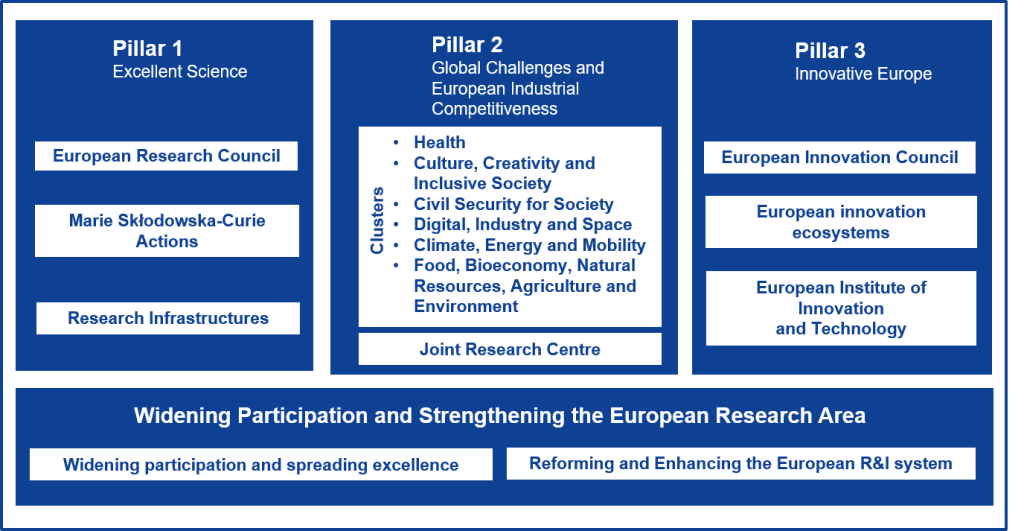
The Framework Programme provides researchers and institutions with extensive opportunities for collaboration and funding. It supports projects across a broad spectrum, ranging from fundamental sciences to advanced technologies, and from climate change to health and digital transformation. Structurally, it is organized around key pillars that foster Scientific Excellence, address Global challenges and European Industrial Competitiveness, and advance Widening Participation & Strengthening the European Research Area (ERA).
Türkiye participates in Horizon Europe as an Associated Country, enabling our researchers to apply on equal terms with their European counterparts. This provides academia, industry, public institutions, and civil society organizations with valuable opportunities to establish international partnerships and benefit from one of the most prestigious funding schemes in Europe. For detailed information, please visit the Horizon Europe website.
📌The latest information on Horizon Europe calls and events is available through TÜBİTAK’s Horizon Europe website, which is regularly updated.
Horizon Europe Programme Structure: Pillars
Pillar I: Excellent Science
Pillar II: Global Challenges and European Industrial Competitiveness
- Health
- Culture, Creativity and Inclusive Society
- Civil Security for Society
- Digital, Industry and Space
- Climate, Energy and Mobility
- Food, Bioeconomy, Natural Resources, Agriculture and Environment
- Non-nuclear direct actions of the Joint Research Centre
Pillar III: Innovative Europe
- European Innovation Council (EIC)
- European Innovation Ecosystems (EIE)
- European Institute of Innovation and Technology (EIT)
Pillar IV: Widening Participation and Strengthening the European Research Area (ERA )
- Widening Participation and Spreading Excellence
- Reforming and Enhancing the European Research and Innovation System
-
Horizon Europe – General Introductory Training
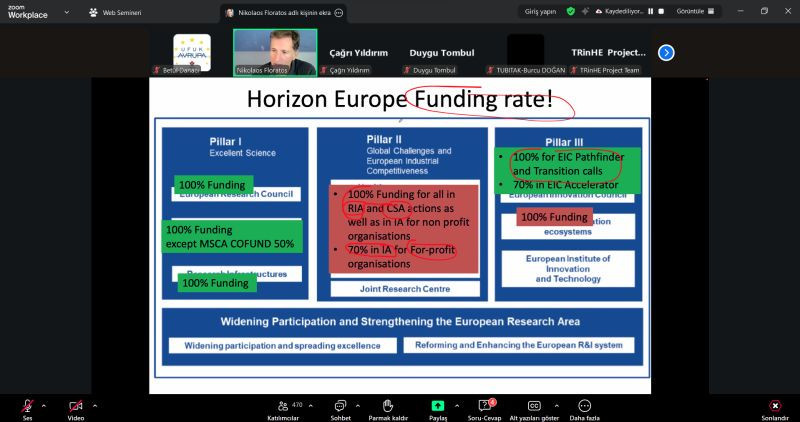
The training was delivered online on 3 October 2025 and offered an introductory overview of the Horizon Europe project lifecycle and cluster structure. In addition to core topics—such as the programme’s architecture and priorities, choosing the right call, and consortium-building strategies—it covered the nuances of proposal and budget preparation and offered practical tips for project implementation. Held under the “Turkey in Horizon Europe” Technical Assistance Project, the session can serve as a starter guide and an accelerator for researchers preparing their first application.
European Union Erasmus+ Programme
Erasmus+ is the European Union’s largest initiative in the fields of education, youth, and sport, offering students and staff valuable opportunities for study, internships, and professional experience abroad. The programme also supports international cooperation projects aimed at bridging the skills gap between education and the labour market.
In addition, Erasmus+ provides opportunities for university faculty members and invited experts to teach at partner institutions, while offering academic and administrative staff the chance to participate in training and internship programmes abroad. Further information is available here.
Jean Monnet Actions
As a distinctive component of Erasmus+, the Jean Monnet Actions aim to promote excellence in teaching and research in the field of European Union studies. They encourage dialogue between the academic community and policy makers, foster knowledge on European integration, and support activities that enhance understanding of the EU’s role in a globalised world.
📌For the latest news and updates on Erasmus+, please visit the Turkish National Agency website.
Instrument for Pre-Accession Assistance (IPA)
The Instrument for Pre-Accession Assistance (IPA) is a financial mechanism of the European Union that supports candidate countries in their reform processes on the path to EU membership. Through this programme, the EU seeks to accelerate political, institutional, social, and economic reforms, while facilitating alignment with EU standards.
Initially provided through different Union programmes and financial instruments, these funds were consolidated in 2007 under a single legal framework, the Instrument for Pre-Accession Assistance (IPA). Since then, IPA has served as the principal financial and technical instrument for candidate and potential candidate countries to meet Union standards. Within this framework, IPA supports the harmonization of national legislation with the EU acquis, strengthens institutional capacity to implement reforms during the accession process, and prepares countries for the rights and obligations of EU membership.
For the 2021–2027 period, IPA focuses on five thematic windows:
- Rule of Law, Fundamental Rights and Democracy.
- Good Governance, Acquis Alignment, Strategic Communication and Good Neighbourly Relations.
- Green Agenda and Sustainable Connectivity.
- Competitiveness and Inclusive Growth.
- Territorial and Cross-Border Cooperation.
📌For more detailed information on IPA, please click here.
EMBO (European Molecular Biology Organization)
Since 1964, the European Molecular Biology Organization (EMBO) has been the global hallmark of excellence in life sciences. It is an elite community bringing together more than 2,700 leading researchers worldwide in the fields of medicine and molecular biology. Its core mission is to build an innovative and supportive research ecosystem where scientists can realize their full potential.
All strategic programs and activities offered by EMBO are funded by the European Molecular Biology Conference (EMBC), an intergovernmental organization comprising 32 member states. This robust structure, of which Türkiye is a member, provides unique opportunities to enhance the global competitiveness of our local research.
EMBO Support Programs and Call Calendar

📌 Important Links
• Official EMBO Programme Page
• TÜBİTAK–EMBO Programme Page
TÜBİTAK International Programs
Bilateral Cooperation Programs: TÜBİTAK conducts bilateral cooperation programmes in science and technology within the framework of intergovernmental and inter-institutional agreements signed with various countries. These programmes provide financial support for joint research projects, scientific events, expert exchanges, and study visits. Applications are submitted online via the TÜBİTAK Directorate for International Cooperation Project Application System (UİDB PBS), where researchers can also access current calls and detailed information.
Multilateral Cooperation: Türkiye actively participates in major European and regional research initiatives such as COST (European Cooperation in Science and Technology) and EMBC (European Molecular Biology Conference), as well as in regional organisations including the BSEC (Black Sea Economic Cooperation), PRIMA (Partnership for Research and Innovation in the Mediterranean Area) and the ECO (The Economic Cooperation Organization). In addition, Türkiye contributes to international scientific activities under global organisations such as the OECD (Organization on Economic Cooperation and Development Global Science Forum) and UNESCO.
Particularly, COST Actions offer valuable opportunities for Turkish researchers to collaborate with international experts, engage in consortia and contribute to high-impact research initiatives of strategic importance for Türkiye. Detailed information is available here.
📌Additional TÜBİTAK International Support Programmes:
- 1071 - Support Programme for Increasing Capacity to Benefit from International Research Funds and Participation in International R&D Cooperation
- 1509 – TÜBİTAK International Industrial R&D Projects Grant Program
- 1709 – Eureka-Eurostars
- 1719 – Eureka Network Calls
U.S. Funding Opportunities (NSF, NHI)
- National Institutes of Health (NIH)
The National Institutes of Health (NIH) is the largest public research funding agency in the United States. It primarily supports projects in health sciences, biomedical research, and public health, offering researchers extensive grant opportunities for basic, clinical, and applied studies. Further information is available on the official NIH website.
- National Science Foundation (NSF)
The National Science Foundation (NSF) is the leading U.S. federal agency supporting research across all fundamental scientific fields outside of health, including natural sciences, engineering, mathematics, computer sciences, and social sciences. It focuses on innovative, interdisciplinary projects with high potential impact. Further information is available on the NSF official website.
British Academy Research Funding
The British Academy is the United Kingdom’s leading institution supporting research in the humanities and social sciences. It offers a broad portfolio of grants for academics, including funding for research projects, collaborations, conferences, and publications. Further information is available here.
British Council Grant Programmes
The British Council provides funding for projects that foster international cooperation in education, culture, and the arts. It supports exchange programmes, joint projects, and capacity-building initiatives, particularly for early-career researchers, artists, and institutions. Further information is available here.
